
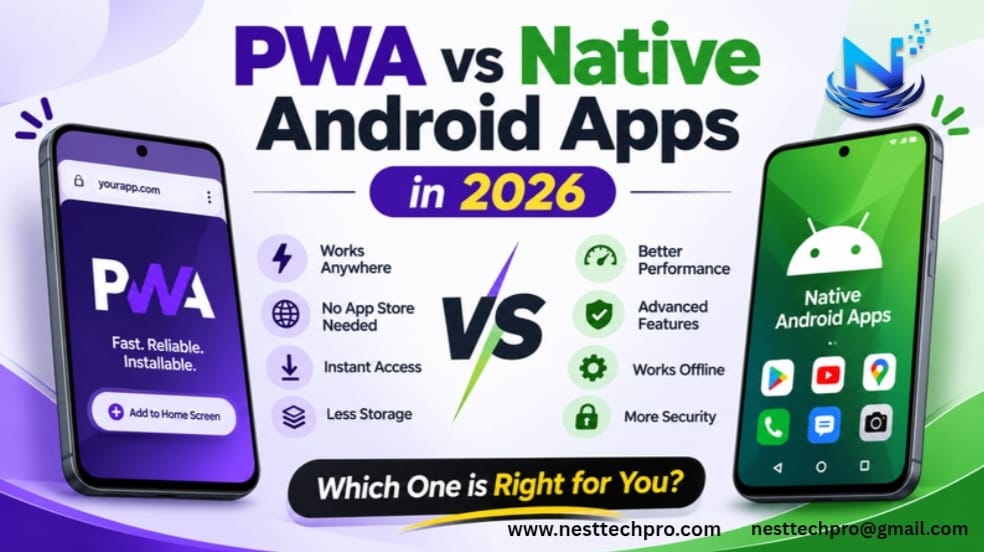
Choosing the right technology for mobile app development can significantly impact your business growth, development budget, and customer experience. In 2026, businesses have two popular options to consider: Progressive Web Apps (PWAs) and native Android applications. Both technologies offer unique advantages. PWAs provide app-like experiences through web browsers, while native Android applications are specifically developed for the Android operating system and offer deeper integration with device features.
But which option is better for your business?
The answer depends on your budget, technical requirements, target audience and long-term business objectives. In this guide, we compare PWA vs native Android app development based on development costs, performance, features, scalability and user experience to help you make the right decision.
1. What Is a Progressive Web App (PWA)?
A Progressive Web App is a web application developed using technologies such as HTML, CSS and JavaScript. It combines the accessibility of a website with several features commonly associated with mobile applications. Unlike traditional mobile apps, users can access a PWA directly through a web browser without downloading it from an app store.
Key features of PWA development include:
Installable directly from supported browsers.
Offline or limited-connectivity functionality through service workers.
Push notifications on supported platforms.
Responsive design for different screen sizes.
Faster distribution through shareable URLs.
A shared codebase across multiple platforms.
PWAs are particularly useful for e-commerce platforms, business websites, online booking systems and content-driven applications.
2. What Is Native Android App Development?
Native Android app development involves building applications specifically for Android devices using platform-supported technologies such as Kotlin and Java. These applications are typically developed using Android Studio and Google's Android development tools. Native applications can access Android hardware and operating system features more directly, making them suitable for applications requiring advanced functionality.
Key features of native Android applications include:
Deep integration with Android operating system features.
Access to device hardware and sensors.
Advanced camera and location functionality.
Background processing capabilities.
Biometric authentication support.
Optimized user interface and interactions.
Distribution through Google Play and other supported channels.
Native Android development is commonly preferred for complex applications such as fintech platforms, gaming applications, healthcare solutions and enterprise software.
3. PWA vs Native Android App Development: Key Differences
Understanding the differences between these technologies makes it easier to select the right development approach.
Comparison Factor | PWA | Native Android App |
Development Cost | Generally lower | Generally higher |
Technology | HTML, CSS, JavaScript | Kotlin, Java |
Installation | Browser or supported app stores | App distribution channels |
Performance | Browser-based | Platform-optimized |
Offline Support | Service workers and caching | Extensive offline capabilities |
Device Access | Browser API dependent | Deeper hardware access |
Updates | Server-side deployment | App update process |
SEO | Web pages can be indexed |
The biggest difference is that PWAs prioritize accessibility and cross-platform compatibility, while native Android apps prioritize platform integration and advanced device functionality.
4. PWA vs Native Android App: Development Cost Comparison
Development cost is one of the most important considerations for startups and businesses. A PWA generally requires a smaller development investment because developers can use one web-based codebase across supported devices. It can also extend an existing website instead of requiring a completely separate application. Native Android development may require additional resources for Android-specific architecture, UI implementation, device testing and ongoing maintenance.
Factors affecting PWA development costs:
UI/UX design and responsive layouts.
Backend development and API integration.
Service worker implementation.
Offline functionality.
Payment gateway integration.
Security and performance optimization.
Factors affecting native Android app development costs:
Custom interface development.
Backend and database integration.
Hardware and operating system integration.
Authentication and security implementation.
Device compatibility testing.
Google Play deployment and maintenance.
Which is more affordable?
For businesses with limited budgets, PWA development is often the more economical starting point. However, the actual cost depends on the number of features, integrations, security requirements and application complexity.
5. Performance Comparison: Which App Is Faster?
Application performance directly affects user satisfaction, engagement and conversions.
Native Android applications generally have an advantage when an application requires intensive processing, complex animations, advanced graphics, or extensive hardware interaction. They can leverage Android-specific APIs and platform capabilities to deliver highly optimized experiences. PWAs run through browser technologies, but modern browser engines offer strong performance. With optimized JavaScript, efficient caching, and responsive interfaces, PWAs can deliver excellent experiences for many business applications.
Native Android performs particularly well for:
High-performance mobile games.
Complex financial applications.
Real-time hardware interactions.
Advanced multimedia applications.
PWAs perform well for:
E-commerce shopping experiences.
Content platforms.
Online booking systems.
Business dashboards.
Product catalogs and customer portals.
Ultimately, performance depends on application architecture, optimization, network conditions and device capabilities rather than technology alone.
6. User Experience: PWA vs Native Android App
User experience plays an important role in application adoption and customer retention. Native Android applications provide a familiar experience because they can follow Android design guidelines, system navigation patterns, and platform-specific interactions. PWAs can also deliver app-like experiences through standalone installation, responsive layouts, offline caching and notifications.
However, some advanced interactions and system integrations may differ depending on browser and device support.
Native Android applications offer:
More extensive device integration.
Consistent platform-specific interactions.
Advanced accessibility and interface capabilities.
Greater control over device-specific functionality.
PWAs offer:
Easy access through website links.
No mandatory app-store download.
Responsive experiences across devices.
Convenient updates without requiring users to install each release.
For applications where convenience and accessibility matter most, PWAs can be an excellent choice. For feature-rich experiences requiring deeper Android integration, native development is generally preferable.
7. SEO and App Discoverability: Which Is Better?
Search engine visibility is another important difference between PWAs and native Android applications. PWAs are built using web technologies, which means their publicly accessible pages can be crawled and indexed by search engines when properly configured.
Businesses can optimize PWA pages using:
Relevant keywords and search intent.
SEO-friendly URLs.
Meta titles and descriptions.
Structured data.
Internal linking.
Mobile-friendly page design.
Core Web Vitals optimization.
Native Android applications do not provide the same direct website-indexing advantages. Businesses can improve app discovery through Google Play listings, app descriptions, reviews and appropriate deep-linking strategies.For businesses targeting local customers, geographic SEO can further improve visibility. For example, an app development company serving Ahmedabad or other Indian cities can create relevant location-specific service pages to reach potential clients.
Verdict: PWAs have a natural advantage for organic search visibility because their web content can be indexed and discovered through search engines.
8. Security, Scalability and Maintenance
Both technologies can support secure and scalable applications when developed using appropriate engineering practices.PWAs require HTTPS, secure authentication, proper API protection, and careful management of browser storage and service workers. Native Android applications can leverage platform security capabilities, secure storage, biometric authentication and Android-specific permission controls. For scalability, both approaches can connect to cloud infrastructure, databases and backend services. Maintenance also differs. PWA updates can be deployed centrally, while native Android updates typically require distributing a new application version, although some configuration and backend changes can be delivered independently. Businesses should evaluate long-term maintenance costs alongside initial development expenses.
9. PWA or Native Android App: Which Should Your Business Choose in 2026?
The right choice depends on your business model and application requirements.
Choose PWA development if:
You want to launch with a limited budget.
Your business depends on website traffic and SEO.
You need cross-device accessibility.
Your application mainly provides content, shopping, or booking functionality.
You want faster deployment and centralized updates.
Choose native Android app development if:
Your application requires advanced hardware integration.
You need complex background operations.
Your product involves intensive graphics or processing.
You require extensive Android-specific functionality.
You want deeper integration with the Android ecosystem.
You can also consider a combined approach: maintain a search-friendly PWA or website while developing a native Android application for advanced customer features.
10. Frequently Asked Questions
Q1. Is a PWA better than a native Android app?
Not always. A PWA is better for accessibility, web discoverability and cost-efficient cross-platform delivery. Native Android applications are generally better for advanced hardware integration and complex functionality.
Q2. Is PWA development cheaper than native Android development?
Generally, yes. PWAs often require fewer development resources because they use a shared web codebase. However, complex offline functionality and integrations can increase their development costs.
Q3. Can a PWA work offline?
Yes. PWAs can use service workers and browser caching to provide offline access to previously stored resources and selected application features.
Q4. Can PWAs send push notifications on Android?
Yes. Supported Android browsers allow PWAs to receive web push notifications, subject to browser capabilities and user permission.
Q5. Are native Android apps faster than PWAs?
Native apps generally offer advantages for demanding workloads and deep hardware integration. However, well-optimized PWAs can deliver excellent performance for many everyday business applications.
Q6. Which technology is better for E-commerce businesses?
PWAs are often a strong choice for E-commerce businesses because customers can discover products through search engines and access shopping experiences through direct links. Native apps may be preferable when advanced loyalty features, intensive personalization, or deeper device integration are important.
Q7. Can a business use both PWA and native Android applications?
Absolutely. Businesses can use a PWA for website accessibility and organic traffic while offering a native Android application for customers who need advanced mobile functionality.
Conclusion
The comparison between PWA vs native Android app development in 2026 shows that both technologies have valuable advantages. PWAs are an excellent option for businesses looking for affordable development, faster deployment, cross-platform accessibility, and better integration with their SEO strategy. Native Android applications are more suitable for businesses that require advanced device capabilities, high-performance functionality, and deeper integration with the Android operating system. There is no universal solution for every business. The best approach is to evaluate your target audience, development budget, required features, and long-term growth plans before making a decision.
Planning to build a mobile application for your business? Choosing the right development technology from the beginning can help reduce unnecessary costs, improve customer experience, and create a scalable digital product.
Useful links
Explore professional website, SEO, and digital growth services.
What Is a Progressive Web App?Explore Mozilla MDN's comprehensive guide to Progressive Web Apps (PWAs) to understand their features, benefits, architecture and how they deliver app-like experiences through modern web technologies.
NesttechProReal products built across web, app, admin, SEO and realtime systems.